New U.S. Embassy – Guatemala
Project Location
Guatemala City, Guatemala
Project Type
– Civic/Government
– International
– Office
Services
– New Construction
Sustainability
– LEED Silver
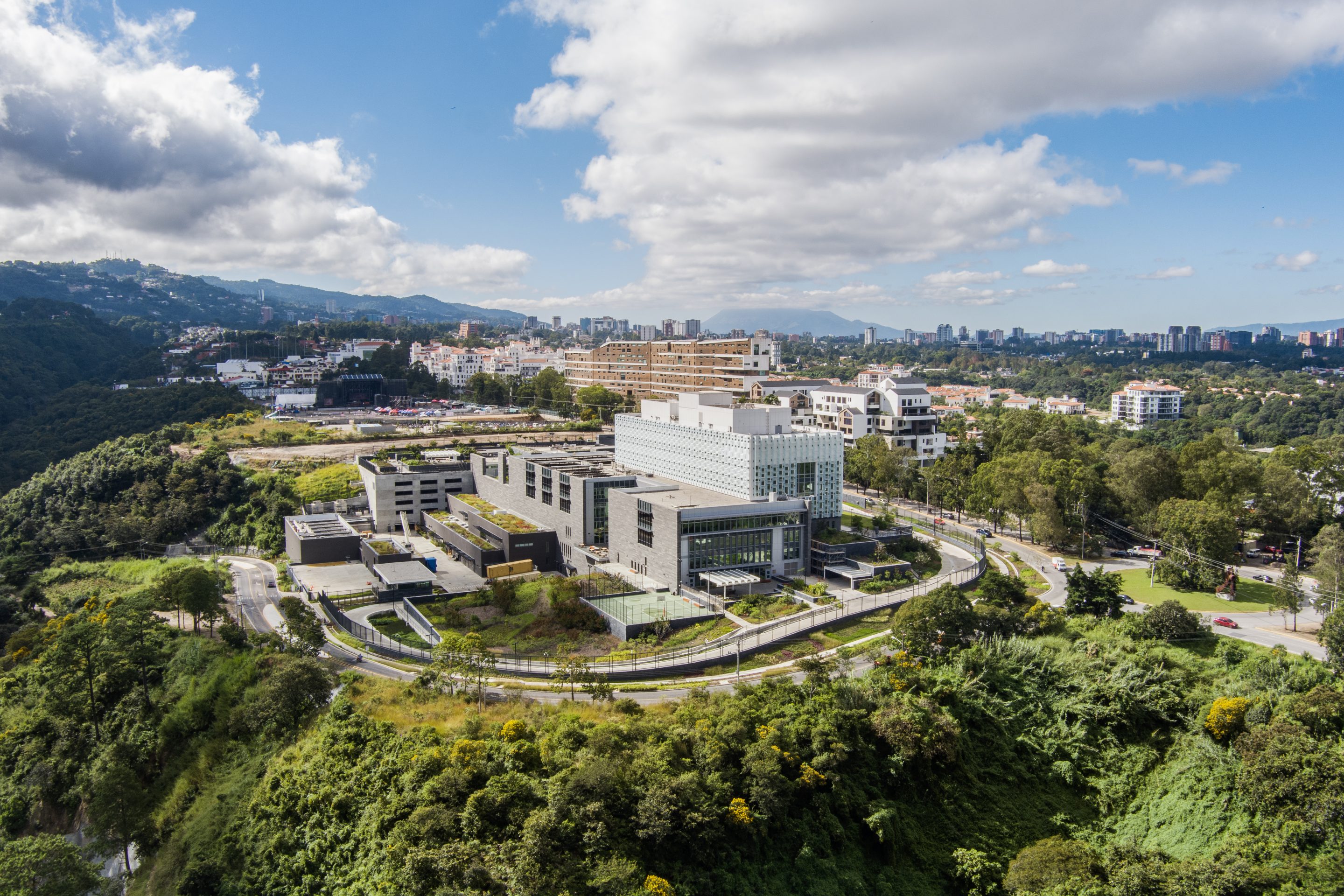
The new campus for the Embassy in Guatemala City, Guatemala consists of seven buildings of varying sizes on a challenging site with extreme grade differences and high seismicity. Highlights of the compound are an 8-story office building built 4 stories deep into the hillside and a 60-foot-tall retaining wall which is incorporated into the structures of two separate buildings to create a lower service court.
The Project
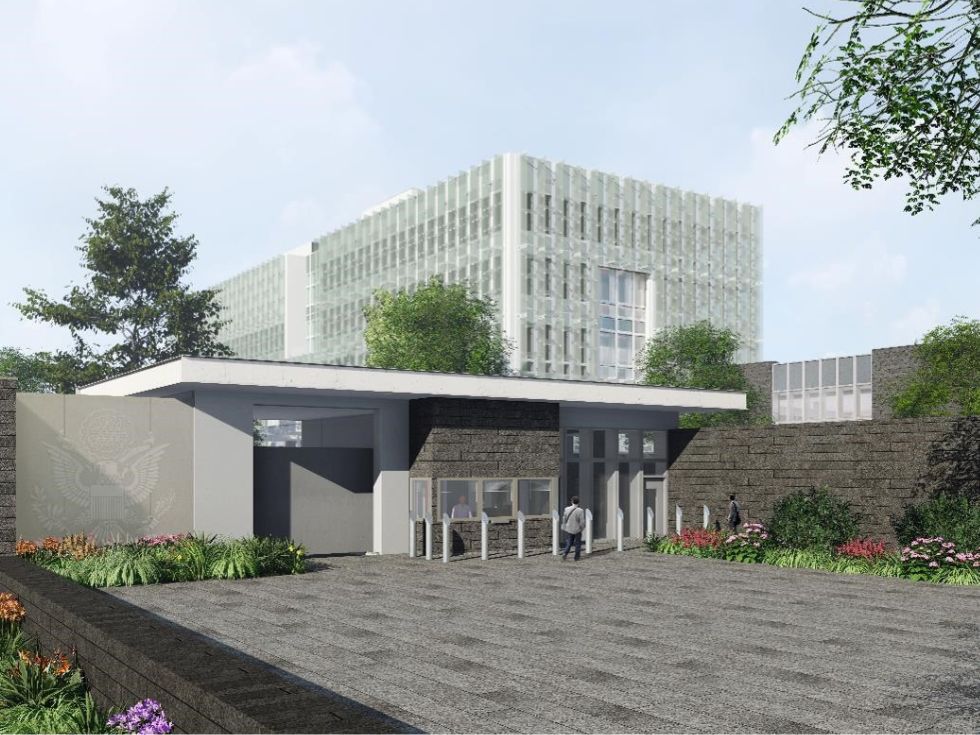
The new campus for the Embassy in Guatemala City, Guatemala consists of an 8-story new office building, a 7-story parking garage, a 2-story support annex retaining 60 feet of soil, a utility building, and three entry pavilions. All buildings are constructed of reinforced concrete.
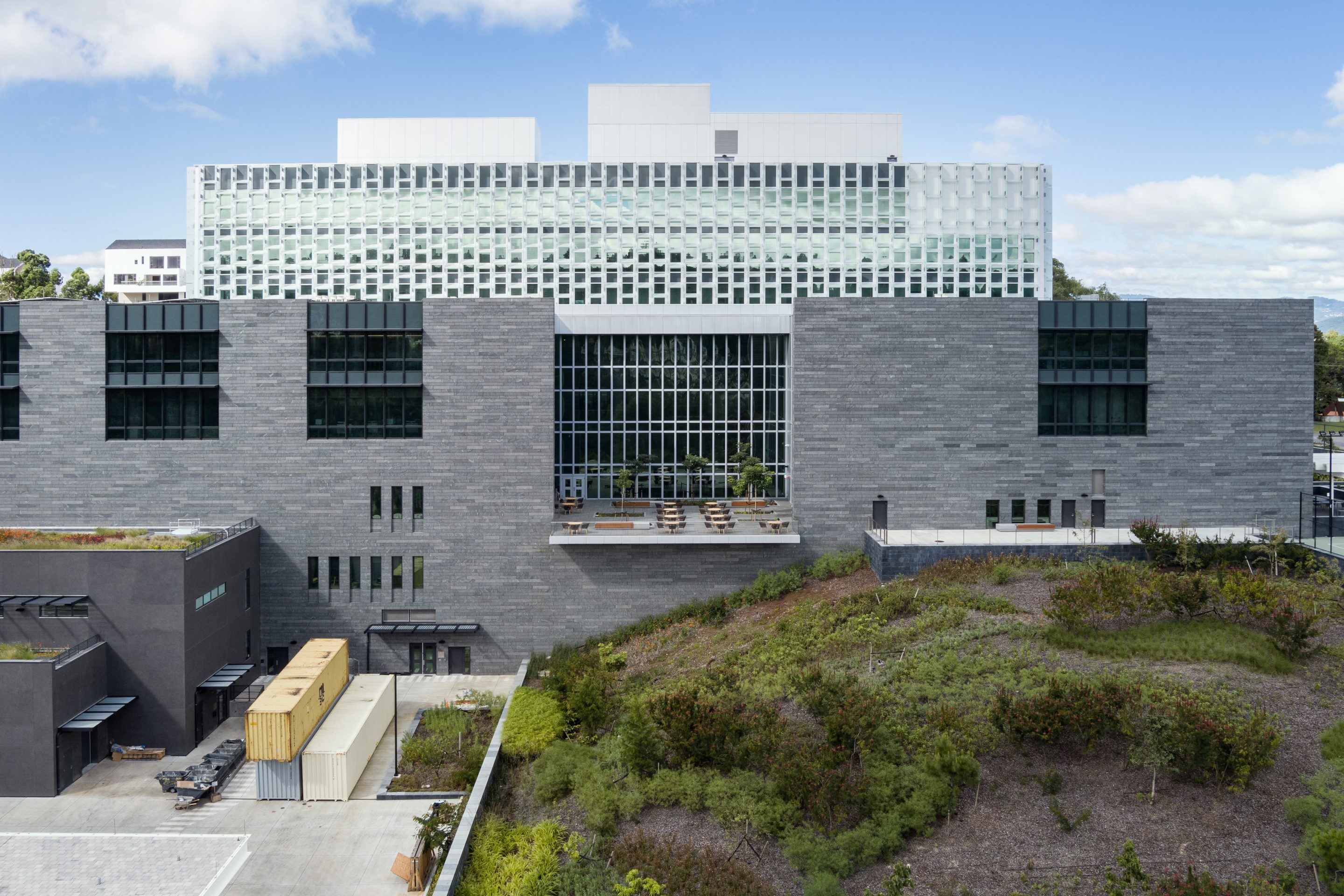
The Chancery is the central focus of the site and is built 4 stories into the hillside. From the main approach, the office building appears to be only 4 stories in height. However, from the rear of the site, the building’s full 8 stories are visible. Its four story “tower” features a glass façade with sunshades designed for blast resistance while the podium steps down as the building encroaches deeper into the hillside.
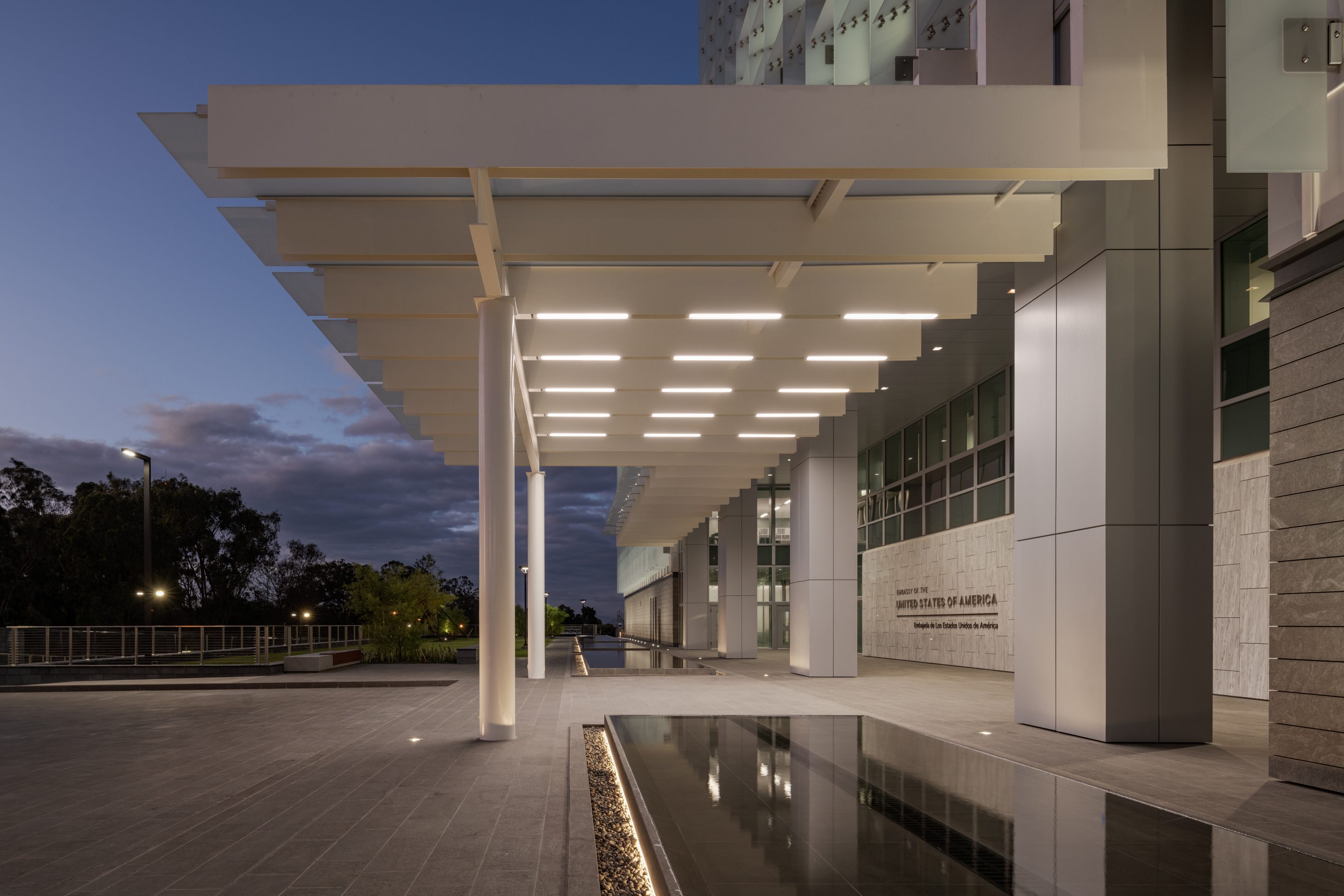
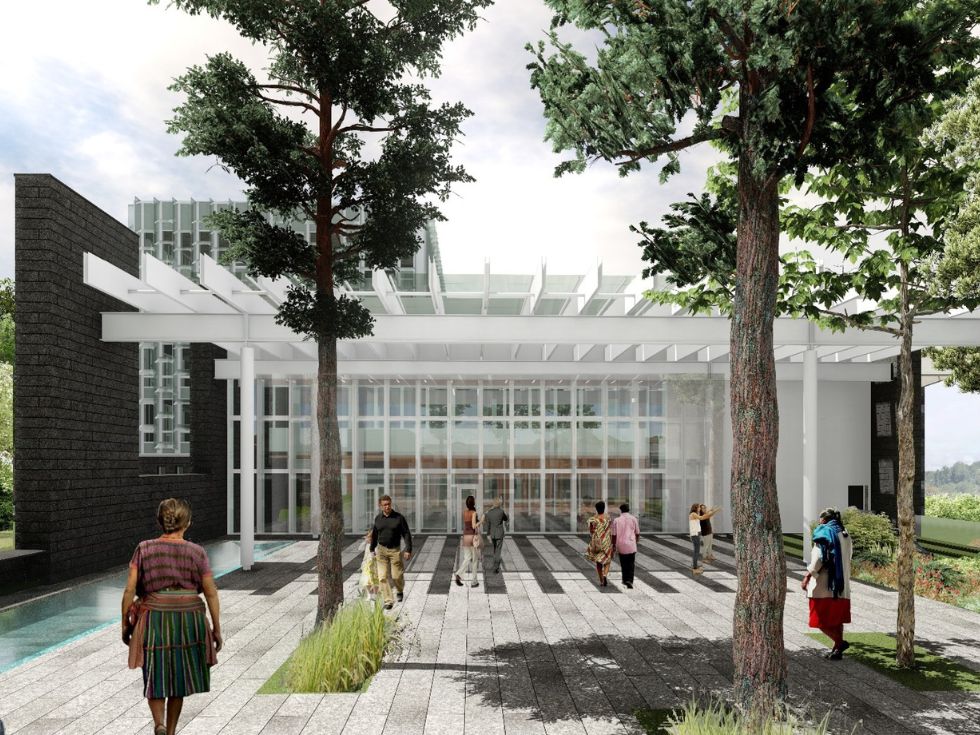
The parking garage is seven stories below grade for approximately three-quarters of the building perimeter, exposing the last quarter to the lower service court. Due to the extreme grade differentials across the site, this seven-story structure has drive-in entrances at the second highest level of the garage and the lowest level of the garage. The top level of the parking garage serves as the representational entry with an intricately landscaped plaza with a drive-through roundabout, canopy, planters, paved walkways, ramps, and conventional and stadium stairs.
The support annex is only a two-story structure but along with the Chancery, parking garage, and retaining wall, they retain more than 60 feet of soil to create the lower service court of the compound. In addition to the grade differential across the site, all structures were designed to meet the requirements of Seismic Design Category D (SDC D). The Chancery was also designed to withstand Blast loads and meet progressive collapse mitigation requirements.
Ehlert Bryan served as the Structural Engineer of Record for all buildings on the site. The Design/Build contractor is B.L. Harbert, and the Architect of Record is Page Southerland Page. The bridging team included the Miller Hull Partnership as the design architect and Magnusson Klemencic Associates as the structural engineer. Ehlert Bryan coordinated the structural design of the buildings with the blast consultant (Thornton Tomasetti), the curtain wall manufacturer (PWS International), the civil engineer (Cowen Design Group), and geotechnical consultant (Schnabel Engineering).
Structural Features
The site for the project was formerly a borrow pit or quarry. As a result, there was an existing extreme grade differential between the north and south sides of the site. The new office building and support annex foundations were designed to retain more than 60 feet of soil to divide the site into two main areas: an entry court on the west side of the site and a service court on the east side of the site.
The task of retaining 60 feet of soil was accomplished using two different systems. The Chancery foundation incorporated a restrained retaining wall spanning more than 60 feet from a mat foundation underneath the support annex to a series of grade beams and drilled piers incorporated into Level 4 of the NOB. The grade beams at Level 4 drag the lateral soil pressure reaction from the top of the retaining wall to drilled piers installed outside the zone of influence of the retaining wall. The drilled piers provide the lateral resistance for the top of the 60 foot wall.
At the support annex, a “counterfort” wall concept was used, in which the retaining wall and its foundation are incorporated into the building structure. While the top of the retaining wall is restrained at the Chancery, the retaining wall at the support annex is cantilevered. The wall spans horizontally to a series of pilasters that are braced by the roof and second floor diaphragms of the support annex, and a series of tightly spaced shear walls transfer the lateral soil load from the floor diaphragms to the building foundation which is a 1.5M thick mat supported by 55 5ft (1.5M) diameter drilled piers.
The parking garage is seven stories below grade for roughly three-quarters of the building perimeter. Due to the northeast corner being fully exposed, unbalanced soil forces were imposed on the structure requiring the use of special floor diaphragm and shear wall designs.